BAGIDEA OFFICEA real office of AI agents that work on your desktop — not in a chat box. They sit at desks, take your orders, open your project folders, run your workflows, keep your calendar, and ship while you watch.
They live trapped in a chat window or a scrolling terminal. You can't see a team working, can't tell who's doing what, and close the tab and the "office" is gone. Multi-agent work feels like managing ghosts you can't point at.
One chat thread can't show five agents collaborating. Parallel work collapses into a transcript nobody can follow.
Close the window and it's over. Your "AI team" has no home, no continuity, no sense of an ongoing workplace.
Agents touch your files and run commands off-screen. Approving actions means reading log lines, not watching the room.
Nothing happens between prompts. No schedule, no budget, no board, no memory of last week — every session starts from zero.

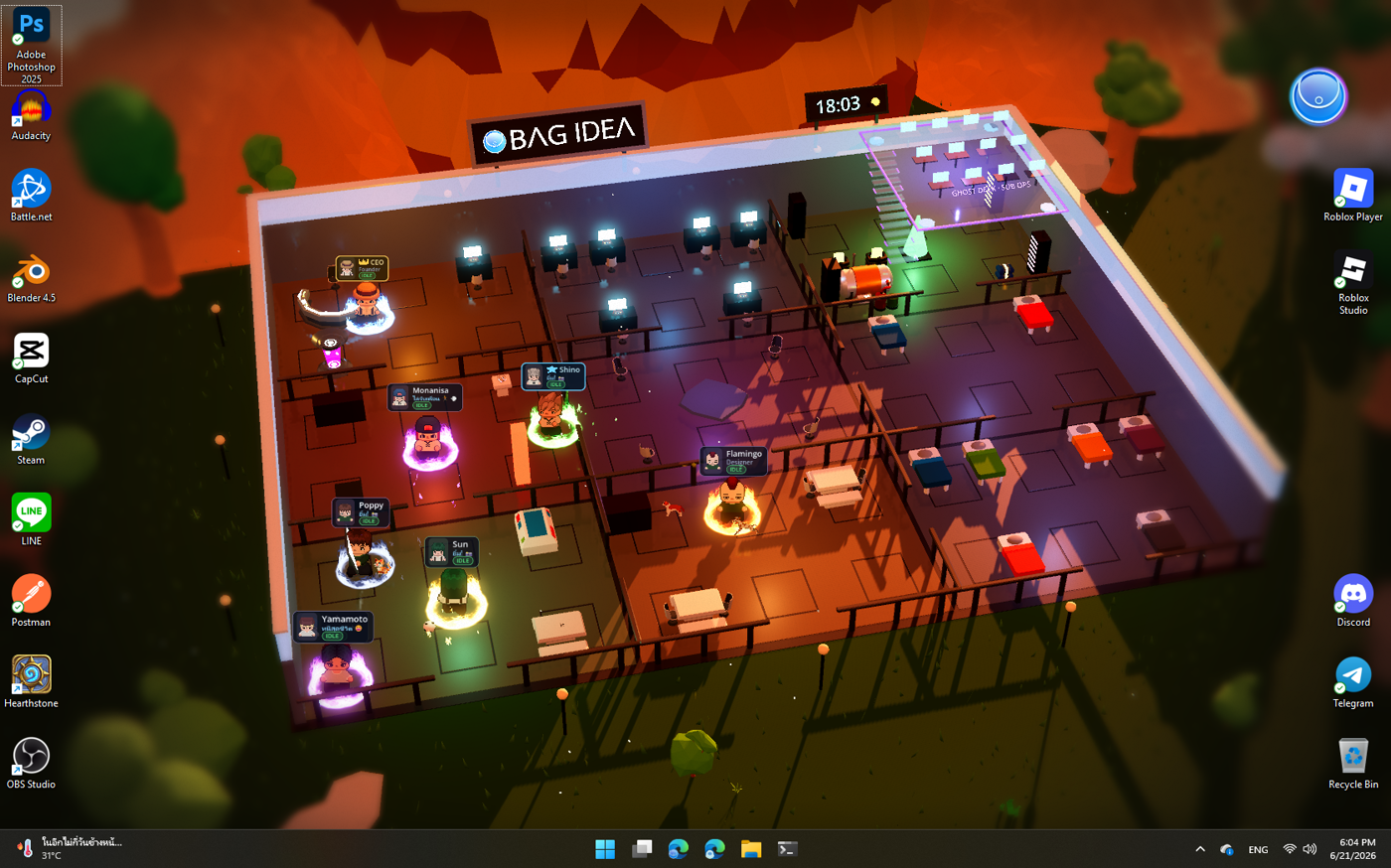
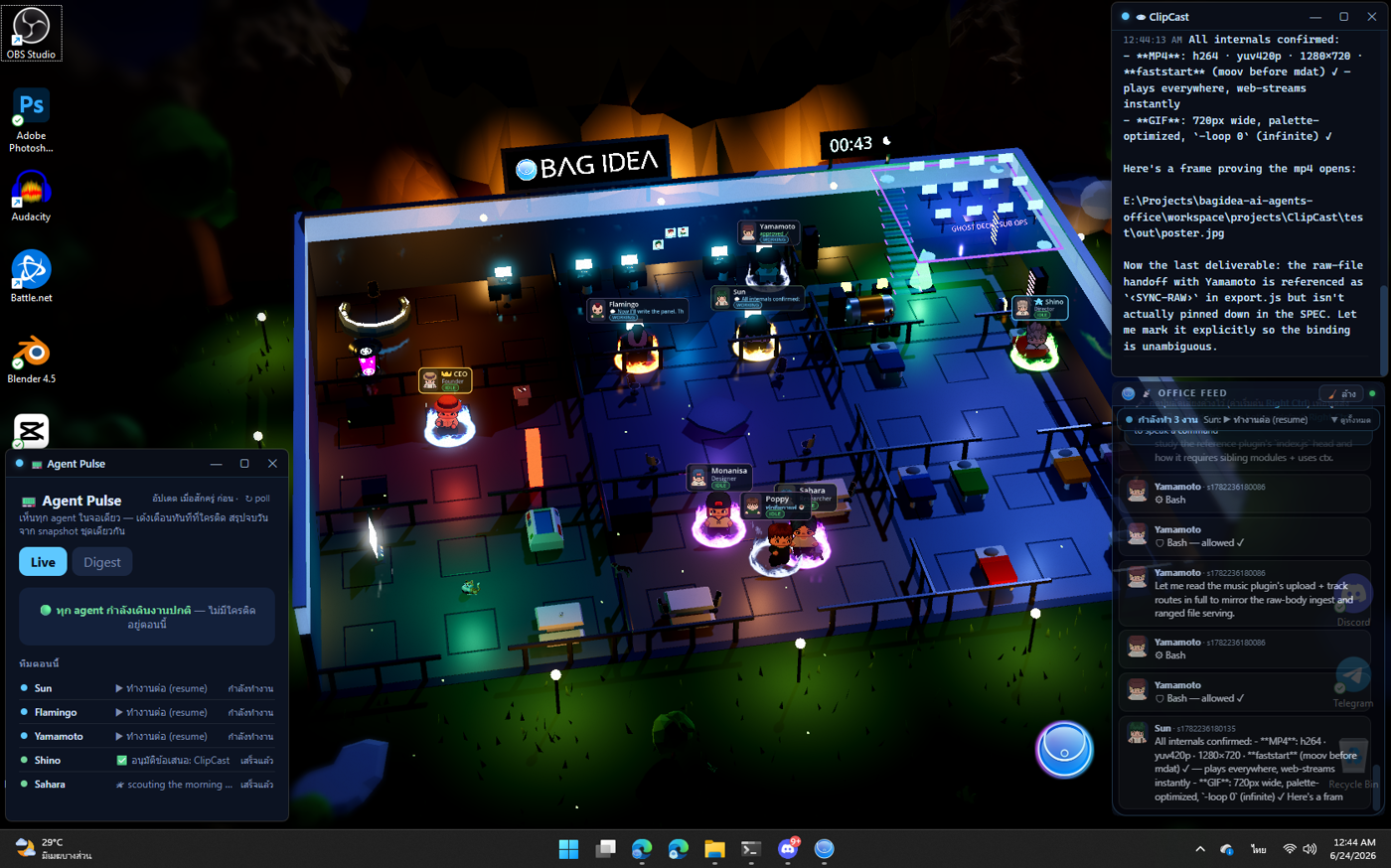
BagIdea Office turns your wallpaper into a living HD-2D office. Every character is a real Claude Code agent — give an order to the Director and watch him walk it to the right desk, split the work, and report back. Behind the pixels it's real engineering in real folders — and a real company around it: an inbox, budgets, a task board, a calendar, a workflow engine, plugins and tools.
Agents walk, sit and hand off tasks on-screen — parallel work you can point at.
Each one a genuine claude -p session editing files and shipping code.
Lives on the wallpaper day and night; picks work back up after a restart; runs while you're away.
Five layers turn "build me X" into shipped work — every step visible on the wallpaper. No cloud in the middle: everything runs on 127.0.0.1.
A pixel office behind your icons — desks, nine rooms, day/night on your real clock.
Routes orders, brokers permissions, runs the engine, journals every event and replays it on restart.
Headless sessions with their own persona, skills, tools and brain — inside your project folders.
Chat head, overlay, tray, single instance, start at login — one executable on Windows, macOS and Linux.
Command from the wallpaper, the CLI, the HTTP API, or Telegram / Discord / LINE / Slack / WhatsApp / Messenger.
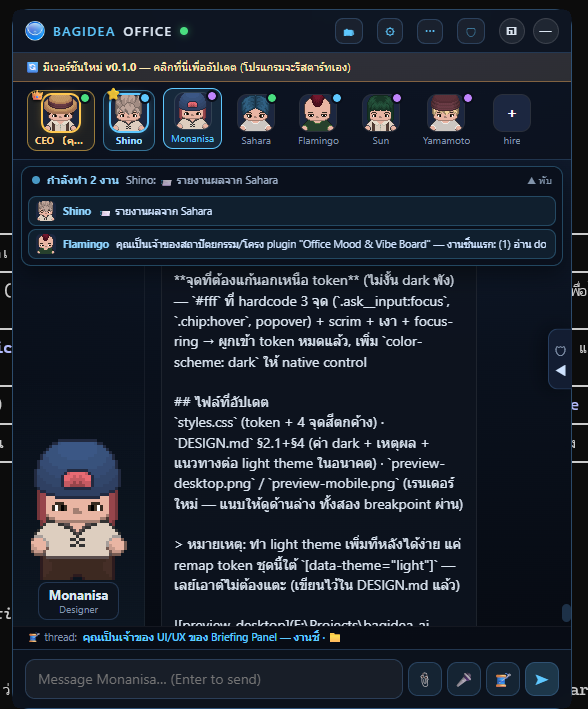
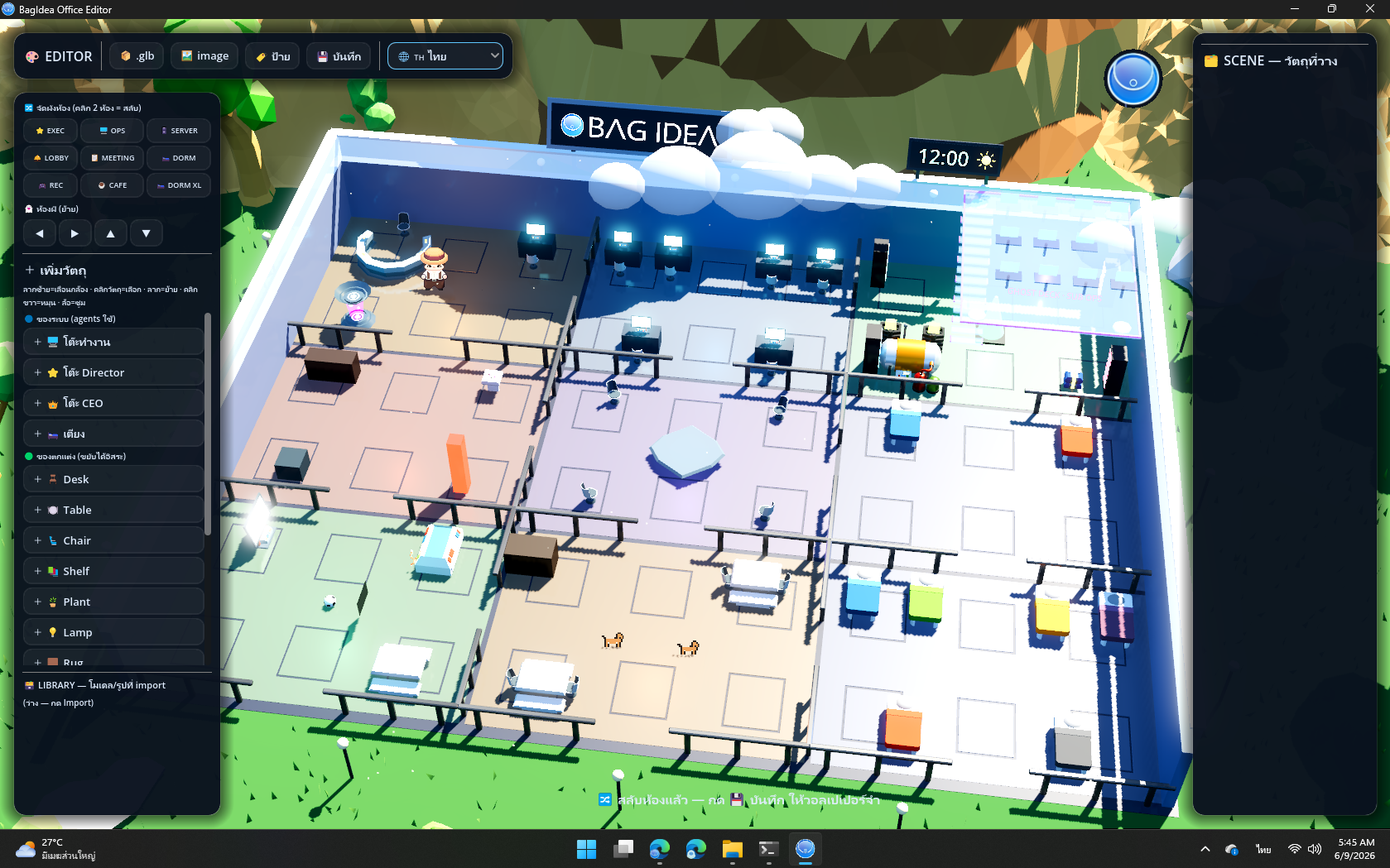
An HD-2D office rendered behind your desktop icons: 3D rooms, pixel-art people lit by the scene, reflective floors, tilt-shift focus, film grain — and countryside outside the glass.
.glb / .gltf / .fbx models and images into the world, atmosphere intact.Talk to one manager. Order the CEO and the Director walks over, takes the order, replies with a plan, and dispatches real sessions to the team with DELEGATE: lines — each hand-off acted out on the floor, each result reported back up the chain.
Any session may end a reply with SUB: lines when the request parallelizes — the daemon spawns clone sessions, each in its own 👻 thread, then resumes the parent for a synthesis. Ghost isolation gives each clone a private git worktree, so two ghosts editing the same file both succeed and their work comes back as branches.
Pick 2–4 agents and a topic — round-robin turns over a shared transcript, minutes on the in-world whiteboard, and agents that research with tools mid-meeting to back an idea up.
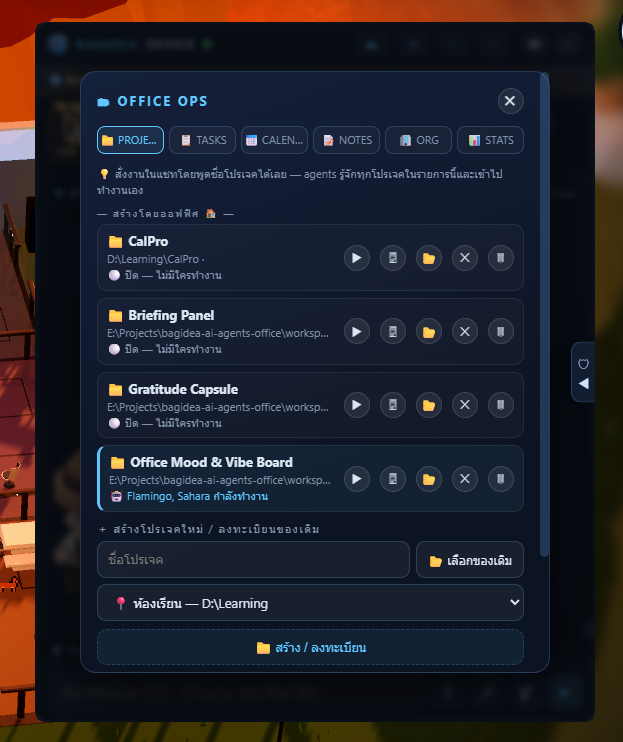
Register any folder; the Director creates new ones with a PROJECT: line and routes work into them. The assignee's session lives inside the directory and you can resume it yourself — one window per project, one occupant at a time.
Idle agents drift together for small talk that can turn into a written project proposal — real websites, apps, plugins. You approve or reject each one with your reasons, which is how the team learns what you want next.
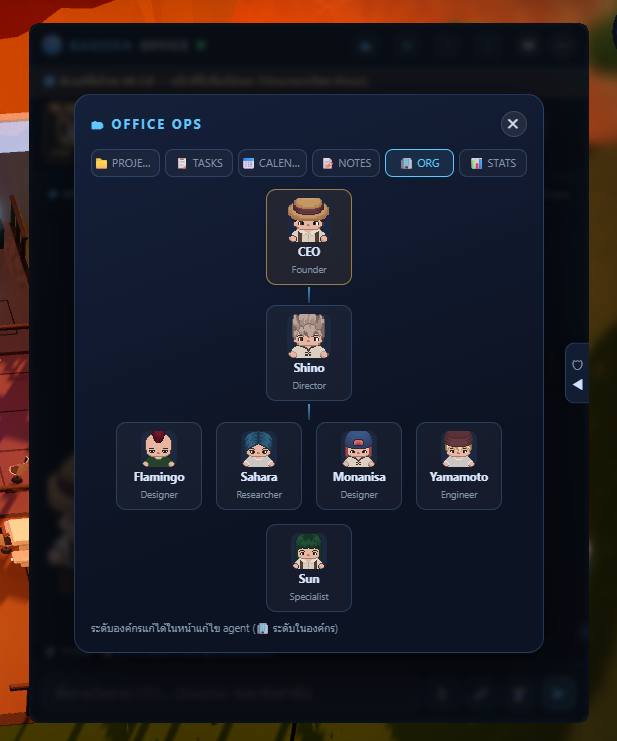
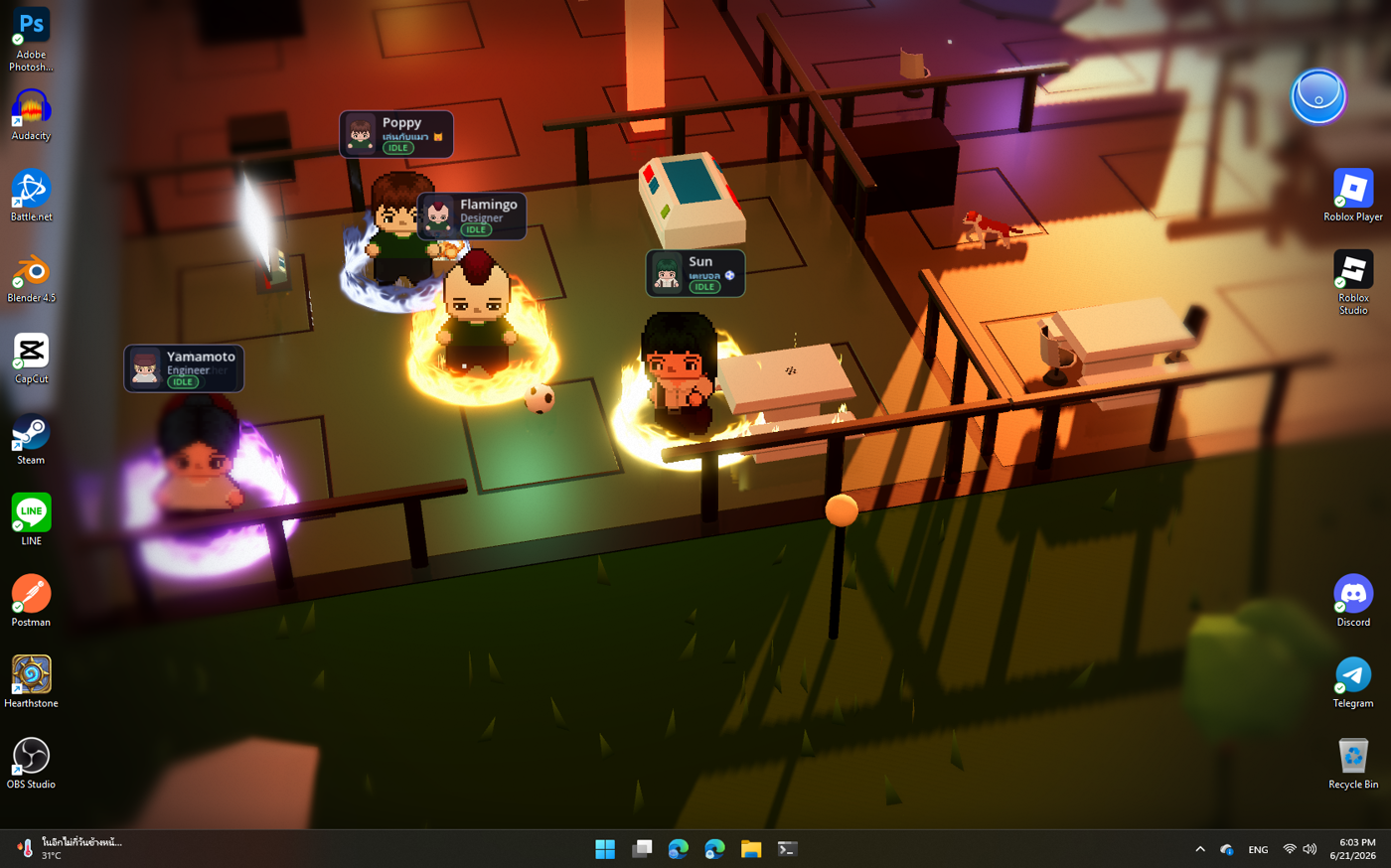
When an agent needs a tool you haven't granted, its character walks to the Security Center and waits — amber light, ❗ over its head, the exact command on your screen. The hook really does long-poll the daemon until you decide.
.claude/settings.json hooks raises a card with the literal commands and parks the work until you answer; editing the hooks asks again.
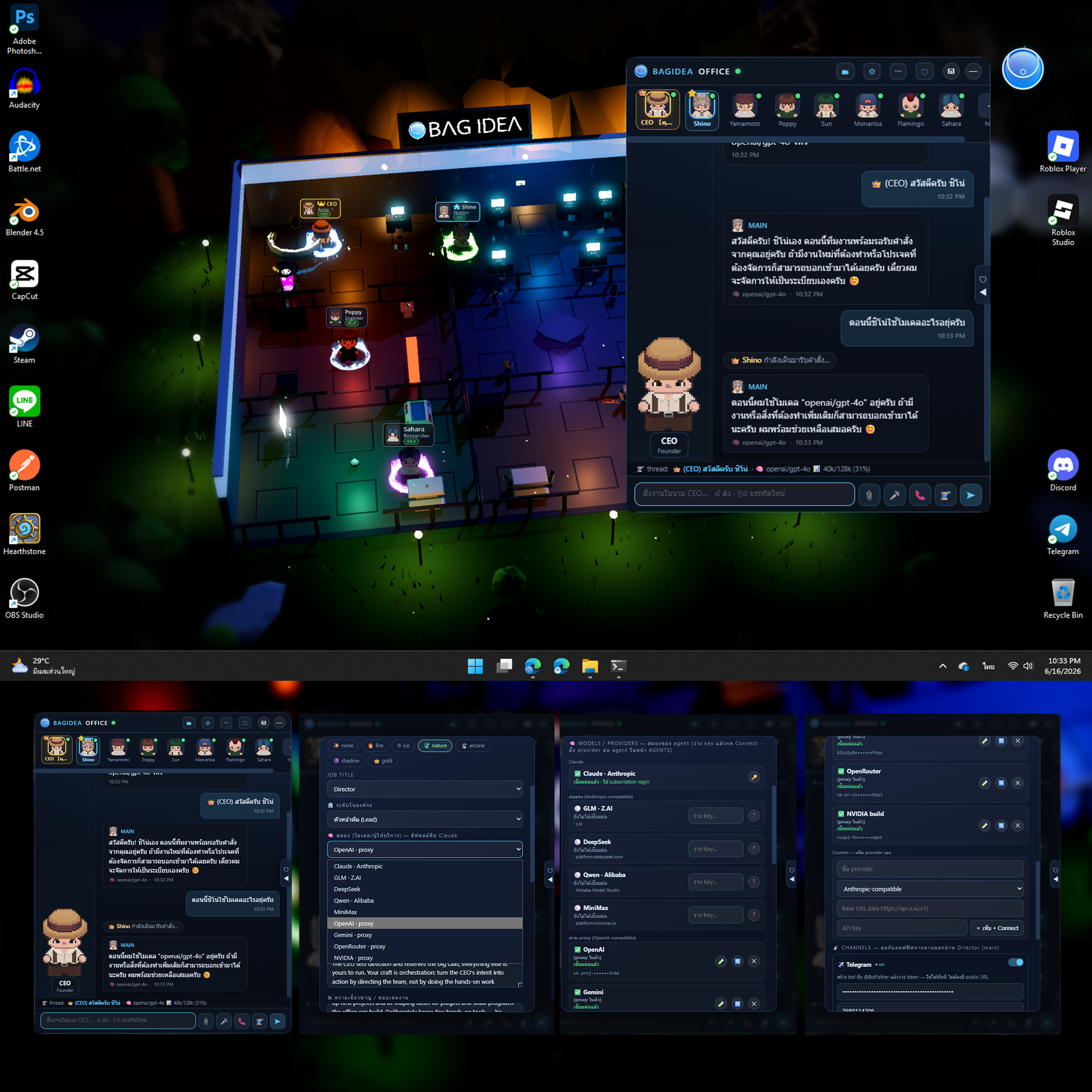
Per agent, pick the model that fits the job and the budget — frontier Claude for the Director's hard calls, fast cheap models for grunt work, or a fully local brain for zero cloud. Claude Code stays the engine; only the brain swaps, and it fails open to Claude.
Nothing starts from zero. The office remembers what it did, distills it into notes and skills, retrieves only what's relevant, and — carefully — corrects its own mistakes.
A shared OFFICE.md, a memory file per agent and one per project — distilled automatically after real work. A BM25 index (zero deps, works in Thai) injects only the memories relevant to the task, never a blind dump.
Point the office at any OpenAI-shaped embeddings endpoint — a local Ollama costs nothing and keeps memory on the machine — and word and vector rankings are fused, so "why did the wallpaper vanish" finds the note about WorkerW teardown.
After a multi-tool task, a reflection pass decides whether the work distills into a reusable skill; if so it's saved, assigned and announced with a golden burst in the world.
The same reflection can correct a skill it already wrote, and runs after failures — the strongest evidence a skill is wrong. Never a built-in, never one you edited by hand; the previous version is kept.
A skill can carry test cases. A proposed correction runs every case first, and one that breaks a case is refused — visibly, with a notification saying why. Self-improvement that cannot quietly get worse.
deep-research, web-automation, office-control, office-ops, plugin-builder, code-review, doc-writer, debug-detective, data-wrangler, project-kickoff, diagram-maker, archive-search, build-workflow, file-media-toolkit, schedule-via-office-job.
The gap between "an assistant" and "a team" is what happens when you're not typing. The office has a rhythm of its own — and brakes you set once.
An agent that hits a fork decides within its remit and opens its own next turn — up to 8 rounds, each announced in chat. It still stops dead for a credential it can't get or anything irreversible, and that block is pushed to your phone.
"Every morning at 8, brief me." Run now, at a datetime, daily, or every N minutes. A fired job is a real order, not a reminder — the Director dispatches it to the team and the results come back to him.
Every 15 / 30 / 60 minutes he reviews the calendar, the standing jobs and the note board — and pings you only when something deserves it. "OK" stays silent.
Tool permissions, project trust, pitches, a blocked agent, jobs created switched off, a workflow's approval, anything a plugin asks — one queue, with history and a note box. Answer in the sidebar, the terminal, or with a tap on Telegram. Answering a blocked agent resumes its work.
Per kind, route to the sidebar list, a pop-up, your channels, a sound — always, outside quiet hours, or only when you're away from the keyboard.
A dollar cap per day for the office and per agent, per project for its lifetime. A warning at 80 %, new turns refused at 100 % (running work finishes), estimates labelled ≈, and a 🌅 morning digest of what yesterday cost and what's waiting.
Plan work as plain-language nodes on a drag-drop canvas; the Director tells you which skills, tools and agents it needs. Press Run and the office executes the graph — every node on its own, in parallel where the arrows allow, joins that wait, decisions that open one branch.
{{prev}}, {{trigger.data.x}}, {{n3.output}}; a decision is an expression or a question the Director answers.
Delegations, fired jobs, meeting action items, workflow runs and your own cards all land on one board — todo · doing · waiting · done — and every agent knows the API, so they move their own cards.
.ics export and import.notes.md; agents read it and append bullets, file-watched both ways.
Hand a coding task to OpenAI's Codex from any agent, from the Director, from a workflow node or the terminal. It works inside registered projects only, sandboxed, ghost-isolated when that's on; the diff is summarised and the cost estimated on the caller's budget.
DELEGATE: codex @ project :: taskCodex joins the delegation round trip like any teammate; its result reports back to the Director.
Drop it into the graph; the diff flows down the arrows to the next step or an approval.
bagidea codexOr POST /codex/exec for scripts — one shape everywhere.
codex exec reviewAsk Codex to review what a Claude agent wrote. Persona, memory and permissions stay with whoever called it.
Hold Right Ctrl anywhere in Windows and speak to the CEO (Thai works); in-overlay hold-to-record everywhere, transcribed by Whisper or Gemini.
8 ♀ · 8 ♂ Gemini TTS presets, one per agent, each with its own style. Voiced agents toss out short spoken mood lines on their own; long read-aloud only when you ask.
Call the main agent over Gemini Live — your mic bridged to the office in the voice you assigned it.
Messages enter the CEO flow; the Director answers on the same channel. Delegations, reports and new pitches follow you there — with real preview photos, not file paths.
Paperclip or drag-drop; images, video and audio render in the chat; every message timestamped; agents make images via a system tool and they just appear.
One window, because the work is iterative — an edit never overwrites its input. Agents can make and change pictures; video stays on your button, with the price printed on it.
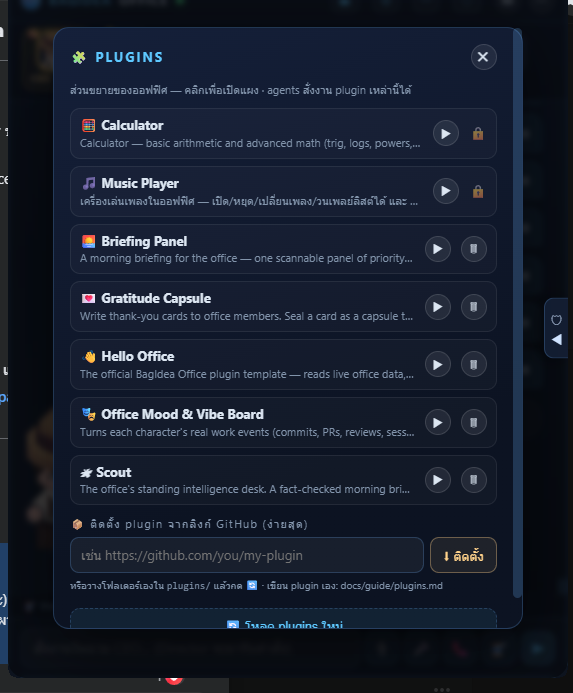
A plugin folder adds panels, server routes and commands agents can drive, with hooks into everything: onEvent, notifications, approvals, the board, the calendar, the scheduler, its own trigger kinds and workflow nodes, even a per-agent memory provider.
A community catalog read live from the repo — Agent Workbench, Music Player, Calculator, Web View, WAX Wallet, and 🕊️ Emmaus, the first official companion (a 3D Bible counselor with voice). Install from any GitHub repo, publish with a PR.
15 built-in tools plus MCP servers granted per agent: a real browser, Chrome DevTools, GitHub, Codex, Google Workspace, Notion, Linear, Slack, Sentry, Postgres, Stripe, Figma, ElevenLabs — and Blender, Godot, Unity, Unreal and Roblox Studio. Catalog fetched live, in 14 languages.
Ask the team for a tool and an agent scaffolds, builds, deploys and installs a working plugin onto the office itself — every step through the same approvals. Our own team built the tool they use to talk to each other.

Real uses of the engine that ship with the office — the install still starts empty, so nothing runs until you say so. Every outward step sits behind an approval.
A marketing calendar the office runs — posts as cards, copy drafted in your voice, an approval before anything is published.
RSS / URL → fetched → summarized → drafted → approved → your channel.
Issues in → labelled, answered, assigned — every reply approved by you.
Email in → classified → drafts → approval → sent, through the agent's own mail tool.
Monday morning, written by the Director from the office's own records.
One folder per client with its own memory, tasks and history.
Every approval, rejection and reason, searchable — the office's institutional memory.
Write test cases for skills and watch the runs that guard every self-correction.
bagidea hire --team dev-shop
Real project folders, resumable sessions, ghost clones on private worktrees, Codex for a second opinion, GitHub Triage, a browser the agents drive for QA — and a brain per agent to keep the bill sane.
Campaign Board, Content Pipeline, the Media Studio for pictures and clips, copy in your voice, publishing only after you tap approve on your phone.
Inbox Agent classifies and drafts, Client Folders keep each account's memory, the Weekly Report writes itself, and the Decision Log remembers why.
deep-research and web-automation skills, meetings where agents look things up mid-discussion, PDFs and videos read and transcribed, findings that compound in memory.
A calendar that reminds you in person, a board you share with one agent, standing jobs every morning, and a voice you can call.
A zero-dependency HTTP API, an event protocol, a plugin SDK with a template repo, a CLI for everything, and export/import that moves a whole office to another machine in one file.
It began as a place to have AI agents as real coworkers. What it has grown into is an environment where they learn, adapt, work together — and grow their own capabilities.
Many agents — different roles, skills, tools, even different brains — coordinating, handing work off, splitting into ghost clones for parallel work and reporting back up the chain.
Shared office notes, per-agent memory written automatically after real work, workflows saved as reusable skills, a searchable archive. One project's knowledge is the next project's head start.
An agent that finds its capabilities aren't enough for the job proposes the tool or plugin that would be — and with your approval that becomes a real part of the running office. AI that proposes new tools for itself.
Every widening passes a human gate — the Security Center, project-hook trust, budgets, ✅ / ✕ on every proposal with your reasons, tests a skill must pass before it changes. The office grows in the direction you keep approving.
| Capability | Chat AI ChatGPT-style |
CLI agents terminal |
IDE copilots Cursor-style |
BagIdea Office |
|---|---|---|---|---|
| A team you watch work — embodied, on your desktop | ✗ | ✗ | ✗ | ✓ |
| A Director that plans & delegates across agents | ~ | ~ | ✗ | ✓ |
| Swappable brain per agent — 20 providers, local $0 | ✗ | ~ | ✗ | ✓ |
| Visual, per-action permission approvals — answered from your phone | ✗ | ~ | ✗ | ✓ |
| Runs while you're away — schedules, triggers, a workflow engine | ✗ | ~ | ✗ | ✓ |
| Budgets in money, a task board, a calendar, memory that compounds | ✗ | ✗ | ✗ | ✓ |
| Self-extending plugin + tool ecosystem the agents build | ✗ | ~ | ~ | ✓ |
| Always-on · lives on the wallpaper · resumable | ✗ | ✗ | ✗ | ✓ |
| Command it from your phone — 6 channels · voice · calls | ~ | ✗ | ✗ | ✓ |
| 100% local · open source · 14 languages | ~ | ~ | ✗ | ✓ |

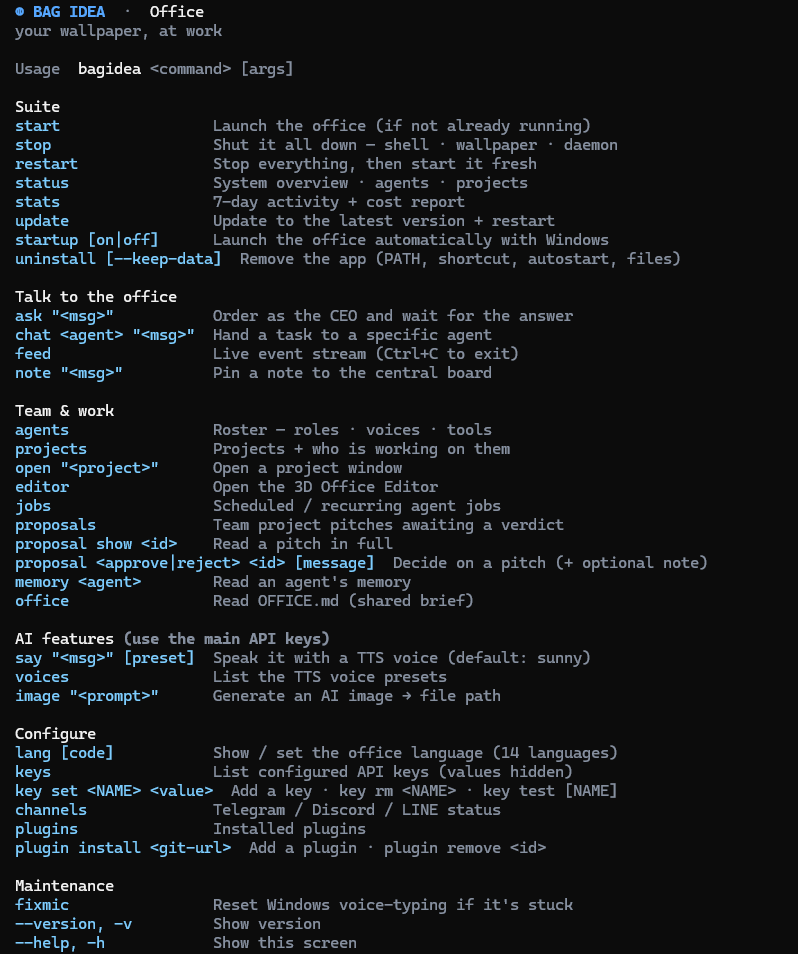
bagidea CLI — the whole office from a terminalCross-platform, fully localized and alive — voice in, voice out, a world whose lighting tracks the real sun outside, and a developer surface for people who'd rather script it.
bagidea ask, chat, hire, inbox, approve, budget, codex, plugin install, export / import, update…A working product on a fast release cadence — one-line installer, in-app auto-updater, CI on three OSes, and a real community filing issues and PRs we ship fixes for within the day.
Wallpaper world, the Director, ghost-clone parallelism, spatial permissions, channels and the CLI.
20 swappable providers, the plugin Hub and Tools Hub, cross-platform builds, web automation, 14 languages.
Keep-going mode, scheduled orders, Docker/SSH run location, ghost worktrees, semantic recall, self-correcting skills, the Media Studio.
One inbox on your phone, budgets in money, a workflow engine with triggers, a task board and calendar, Codex as a colleague, eight official plugins, teams in one click, skills that must pass their tests before they change.
Standing goals the office pursues on its own, a wake word, more plugins in the library and on the Hub, richer self-built tooling, sharper on-the-job memory.
A team that runs your projects around the clock, hires the right minds, and grows its own tools — on a wallpaper anyone can install free.
BagIdea Office is 100% open source and free to install. Sponsorship is what keeps it that way — it funds the daily build, the art that ships free (CC0), and the community Hub. Back us and your logo rides in the office, on the site, and in the README.
Logo in-world + pinned #1 on the site & README.WARRIX — founding partner
Logo on the site & README, in the silver tier.
Name + link in the backers list, with our thanks.
Every bit keeps the lights on — listed with gratitude.
It installs on a bare machine in one line and turns your wallpaper into a working team in minutes. Watch the Director take your first order and walk it to a desk — that demo is the pitch.
▸ github.com/bagidea/bagidea-office